




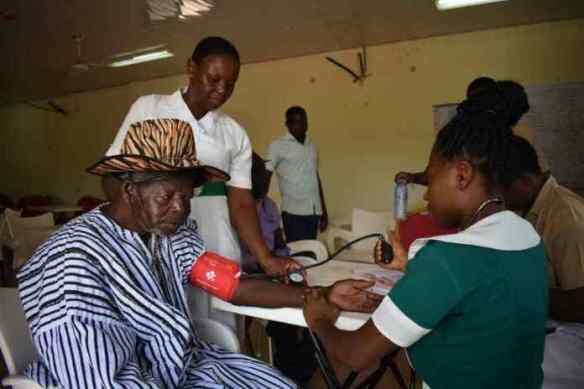
– A story of how Wa West District hospital at Wechiau is using technology to improve health care delivery.
Madam Nafizatu Abukari, a 27 year – old expectant mother delayed in reporting to the hospital for several hours after a rapture of the membranes (when her water breaks). Her uterus dilates until the baby started to present, but with the leg.
Stuck in between her legs, family and friends looked on as she laboured on with deep groaning and screams until both mother and baby became weak. Finally, someone called the Wa West District hospital based at Wechiau where all cases that go beyond primary health care are referred.
The only resident medical officer at Wechiau District Hospital who dabbled as a Medical Superintendent, Dr Benjamin Aminyuure quickly despatched his official 12 year -old Pick-up vehicle to convey the maternal case in lieu of the hospital’s broken down ambulance.
Dr Aminyuure then got his Theatre and staff ready and in wait for the arrival of the expectant mother from Gurungu, about 19 kilometres away from the district hospital at Wechiau.
Dr Aminyuure told the Daily Graphic with a sense of pride that a cesarean session performed on her was successful and that saved the mother and baby who are currently hale and hearty.
He cited the case to buttress how three forms of delay, namely reporting to health facilities, transportation to health facilities and medical interventions has contributed to maternal mortality (child delivery related deaths ) in the region and in deed in the Wa West District.
However, the Health Directorate has instituted measures to address each of the identified challenges with the support of various Assembly members, Member of Parliament, traditional authorities, elders and general public in the 226 communities the hospital served.
The delays, it had been observed borders on first, taking a decision to report to the hospital for antenatal cases, especially when they turned out to be an emergency. Sometimes, after the decision to report had been reached, the woman in labour has to either wait for instructions from her husband or means of transport to get to the health facility.
Dr Aminyuure said, sometimes interventions at the hospital also delayed in administering the required intervention in such cases. Poor attitudes on the part of the health staff such as being extremely harsh and sometimes, physically assaulting expectant mothers during delivery also result in withdrawal symptoms and discouraged some mothers from attending antenatal sessions, much more report for health interventions when required.
The Medical Superintendent who arrived at the facility about a year ago realised from the hospital’s annual review that the four Community -based Health Planning Services (CHPS) zones had 171 home (unskilled ) deliveries , suggesting that the women preferred to deliver on their own instead of seeking the services and support of experts at health facilities.
“I decided to organise community durbar across the four CHPS zones to find out more about the dwindling confidence of the people in the health service providers early this year. The frank deliberations with the stakeholders brought up reasons why they did not patronise the skill deliveries in the CHPS zones and hospital, ” he said.
Other reasons, according to the people included the poor road network, inadequate means of transport to access the facilities and the poor attitude of the Midwives towards the patients for whom they have been employed. Another challenge was also top-up (extra) charges the hospital charged expectant mothers many of whom could not foot the bills.
Remedies
Foremost, the Wechiau District hospital took up the transportation of pregnant women to the facility, free of charge.
“We instituted free ambulance services for maternal cases, beginning with the four CHPS zones. Later, we involved other sub – districts where there are health centres and eventually extended it across the entire district,” he recounted.
Technology
The hospital also created a WhatsApp platform for maternal and child health care delivery involving the all the stakeholders of the District Health Directorate .
“What happens is that if there is a maternal case that will require hospital delivery in any of the sub-districts, it was put on the WhatsApp page with the key facts .
This enabled the Medical Superintendent to play an oversight role over all labour cases and based on his advice, the situation was expected to be resolved within four hours before further action, if any.
Dr Aminyuure said, when the case needed a referral to his facility, the Ambulance was immediately despatched or in his absence, his 12 year – old Pick-up vehicle came in handy. The platform also discussed maternal and child health care issues to keep one another in tune with trends.
The third intervention to prevent maternal and child mortality was the abolition of the top-up charges which included purchases of items such as detergents, pads and rubber sheets to serve as macintosh for the delivery, with the hospital underwriting that bill on internally – generated funds (IGF). Series of staff durbar has also been organised to assist the staff to change their minds and attitudes toward maternal and child health care.
Additional measures
The hospital authorities have also asked the traditional authorities to institute some kind of “bye – laws ” that prevailed on pregnant women to attend Anti-natal services and sanctions on husbands whose wives deliver at home.
“For the road network, we continue to plead with the District Assembly and government to assist with that because we cannot do much about that ” Dr Aminyuure said.
Outcomes
This measures have contributed significantly to changing the story from one of sadness to positive outcomes with zero maternal deaths by half year, this year.
According to figures sighted in the hospital’s half year report, the district recorded 178 skilled deliveries (deliveries in health services ) as against 124 skilled deliveries last year. The deliveries included 29 Caesarean sessions with the rest being through spontaneous vaginal deliveries. This compared favourably with half year of last year when 97 CS deliveries were recorded.
Due to the measures, especially with the prompt reporting to health facilities, Dr Aminyuure said only three maternal cases had been referred to the regional referral hospital at Wa. Two cases of uterine raptures as a result of delays in reporting had been successfully managed at the facility, a feat he said, was boosting the confidence level of both staff and clients in the facility.
Way forward
Dr Aminyuure said, whilst the hospital would continue to improve on the achievements, it will strengthen laboratory services to enhance maternal care delivery.
For its IGF, the hospital would run a mobile laboratory where it would move round to take samples of pregnant women and run the labs for them under the cover of the National Health Insurance Scheme (NHIS). He also appealed to the government to augment the staff strength of the hospital, especially with additional medical officers, mechanised staff including a number of them for the Pharmacy.
Background
The Wa West District hospital started as a health post, went on to become a health centre before elevated to a district hospital in 2014, exactly a decade after Wechiau was established and created as a district capital.
The hospital became NHIS registered facility in 2016.
Currently, serving about 200 Out – Patients Department (OPD) cases daily, the hospital services about 226 communities with a total population of 95,92 people.
The young district also boast of four CHPS compounds, 30 health centres, seven maternal homes, two private health facilities, all of which have the Wa West District hospital as their point of call when it comes to referrals.
Source: Emmanuel Modey, Wcapital





 upperwestmedia.net
Leave a Reply