


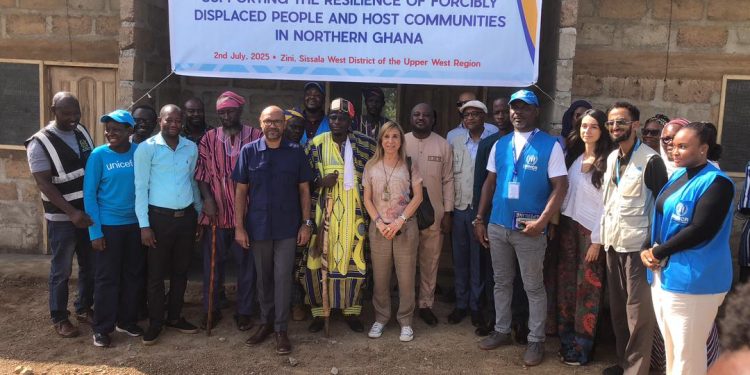
1,100 refugees from Burkina Faso are set to receive dignified shelter and improved social support in the Upper West Region as part of a new multi-agency humanitarian initiative.
The project, launched by the European Union (EU) in partnership with UNICEF, UNHCR, and the Ghana government, is part of a €2.7 million regional programme designed to strengthen the resilience of forcibly displaced persons and their host communities.

Known as the UNITE Project, the intervention will be implemented in the Tarikom and Zini communities of the Upper East and Upper West regions, respectively.
According to UNHCR estimates, over 17,000 asylum seekers from Burkina Faso have fled into northern Ghana due to prolonged conflict in the Sahel region. Many of them currently live in makeshift shelters, raising concerns about safety, dignity, and access to basic services.
Speaking at the launch of the project, EU Ambassador to Ghana, Mr. Irchad Razaaly, on Wednesday, July 16, reaffirmed the EU’s commitment to supporting displaced populations.
“Through the UNITE Project, the EU is helping to provide refugees and their host communities with not just temporary relief but long-term, sustainable solutions in line with human rights and international obligations,” he said.
The project will prioritise the construction of safe, climate-resilient housing for the most vulnerable refugees in the Upper West Region. It also includes expanding access to electricity and improving essential services such as healthcare, education, and water and sanitation.
UNICEF Ghana Representative, Mr. Osama Makkawi Khogali, described the initiative as a commitment to restoring dignity. “This is about building a future where every child and family has equitable access to services and opportunities,” he stated.
The project is being delivered in partnership with Ghana’s Ministry of Gender, Children and Social Protection, the Ghana Health Service, the Ghana Education Service, the National Identification Authority, and local government and traditional authorities.
In addition to providing housing, the initiative will rehabilitate health facilities, expand the National Health Insurance Scheme (NHIS) for displaced mothers and children, support birth registration, and strengthen child protection systems.
The UNITE project is part of a broader €12 million regional effort also covering Côte d’Ivoire, Togo, and Benin, with the EU contributing €10 million and four UN agencies, including WFP and IOM, contributing €2 million.
The Paramount Chief of the Buwaa Traditional Area, Kuoro Abu Diyaka Sukabe Ninia V, said that people fleeing persecution must be supported to rebuild their lives with dignity, in line with international treaties and shared humanity.
He stated that the traditional council encourages residents to release fertile land to refugee settlers to promote inclusion.
He added that 200 acres of land have been allocated to the refugees for farming, but called for the intervention of the EU, UNHCR, and the Ghana Refugee Board to help formalise rental and release agreements.
Samuel Dzikunu, Head of the UNHCR Field Office in Ghana, announced that on January 30, 2025, the Government of Ghana officially recognised the Burkinabe nationals as refugees under the prima facie approach. He explained that this recognition grants them legal refugee status, meaning they are no longer considered asylum seekers.
As a result, the refugees now fall under the full protection of both international conventions and Ghana’s refugee laws, entitling them to access the services and support that Ghana, as a signatory to various international treaties, is obligated to provide.
Source: Citi FM





 upperwestmedia.net
Leave a Reply